Bubble growth from a confined space
2024 → present
Tom Marzin, Juilen LeDruff, Abigail Plummer, P.-T. Brun
Some work in progress: we are studying the shape of the free surface of expanding foam. This material is commonly used inside objects as insulation, seat cushions, or economical void-fill in lightweight structures, where it is typically fully enclosed. In our study, we remove some (but not all) confinement to learn how the shape of the free surface evolves with expansion.
We find that the shape of the foam surface depends on the shape of the container from which it grows. For shallow cavities, we observe a family of shapes that resemble classic Young-Laplace sessile droplets, which balance surface tension (experimentally determined and quite large compared to a typical fluid like water) with gravity across an interface. Beyond a certain cavity depth, this model fails to predict the observed shape, as the foam appears to pin at the boundaries, extruding vertically rather than spreading.
We are also interested in how growing droplets interact.
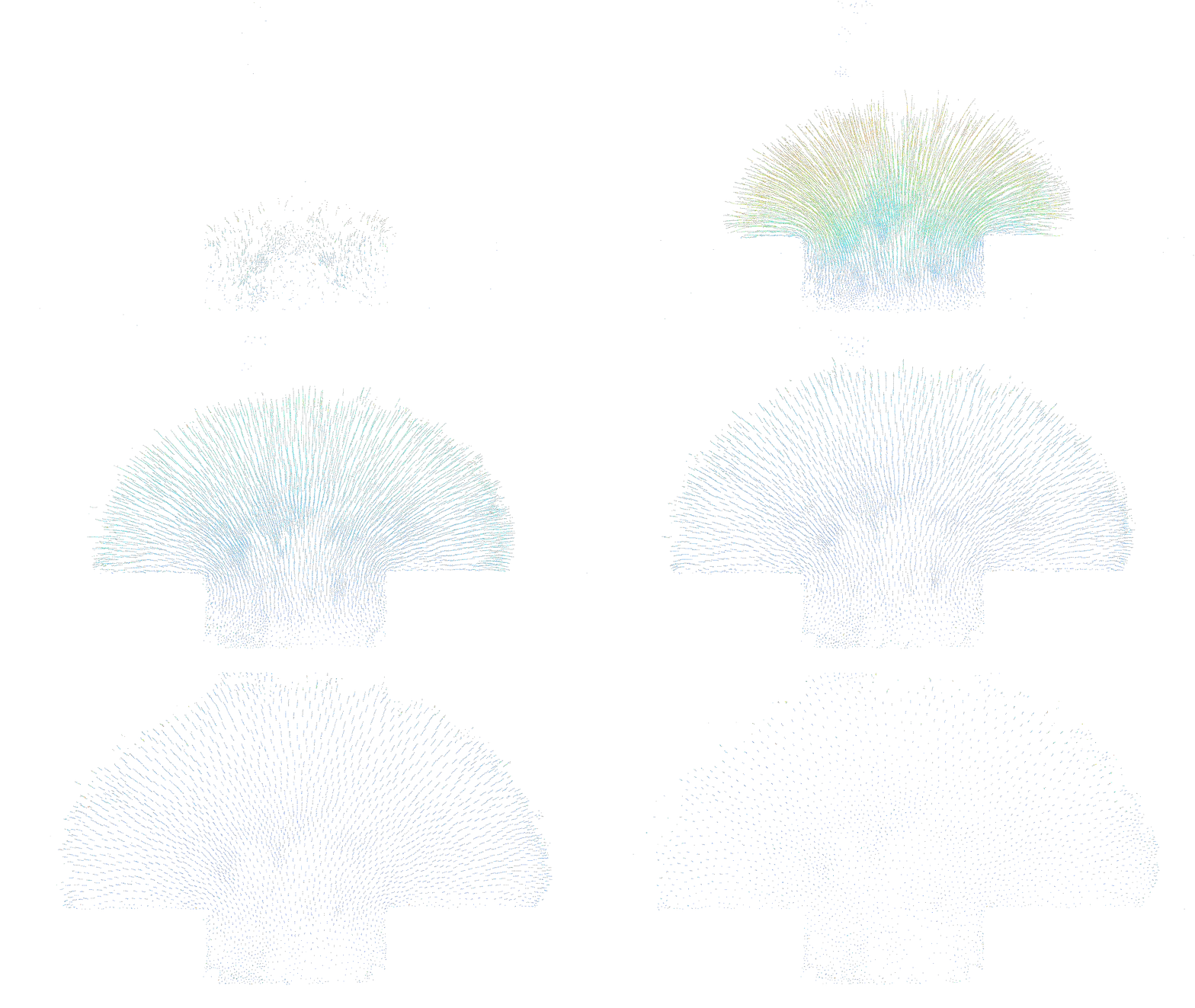
These micro-CT slices show two foam droplets that have collided during growth. Thousands of individual cells have been segmented in 3D and color-coded by orientation: darker blues indicate vertically aligned cells, while whites represent cells oriented in-plane. While collisions have a minimal affect overall drop height, we see some spatial patterning of bubble size and shape that suggest interaction.

Micro-CT images provide signatures of flow but offer limited insight into growth dynamics. To study this more directly, we examine bubbles expanding in quasi-2D Hele-Shaw cells. Although the additional confinement significantly alters the problem, it allows us to track the size and location of bubbles in time. We see that bubbles move fastest just as they exit the cavity.
← Previous:
Viscous delugeNext: →
Faceted fabrics